The past six months have seen AI evolve from novel tool to strategic infrastructure, with major advances in model capability, infrastructure, science-facing applications, and real-world deployment. New frontier models (e.g., Gemini 3, Nova 2 / Nova Forge), breakthroughs in R&D (e.g., BoltzGen) and robotics (embodied AI and robotics on the International Space Station) are expanding what AI can do, from reasoning across media to designing molecules, anticipating faults, and powering autonomous systems. Meanwhile, AI adoption is shifting from isolated pilots to enterprise-wide infrastructure, with evidence from the recent McKinsey & Company survey showing high performers increasingly embed AI into operations.
Despite hype and investment, nearly US $2 billion weekly in generative AI in early 2025 according to reporting, real-world impact remains uneven. This report outlines these developments, regional and sectoral distinctions, early adoption signals, and actionable guidance for leadership.
Overview of Recent Innovations in the Sector
Emerging Themes & Categories with High Innovation Activity
- Agentic and multimodal AI agents: The shift from chatbots to autonomous “agentic” AI that can plan, execute, and reason across modalities is accelerating. Gemini 3, Nova 2, Nova Forge, and new generative robotics models exemplify this.
- AI for science, health, and real-world material design: AI is increasingly being used not just for content or commerce, but for scientific discovery, from molecule design to robotics on the ISS.
- Infrastructure and compute innovation: There is growing emphasis on building in-house compute (chips, servers), open-source models, and synthetic data pipelines, signalling maturation of AI as infrastructure rather than experimental novelty.
- Responsible AI and “human-AI symbiosis”: Recognition grows that AI must co-exist with human cognition, not just replace tasks. The recent CHI 2025 “Tools for Thought” research agenda captures this shift.
Drivers of Innovation
- Competitive pressure & capital inflows: Venture capital remains massive for generative AI and frontier models, estimated at roughly US $2bn per week in H1 2025.
- Strategic infrastructure investments: Organisations increasingly view AI as core infrastructure rather than optional add-on, embedding AI into operating models to capture value at scale.
- Science and societal challenges: As public and governmental bodies push for AI to deliver on healthcare, climate, energy and scientific discovery, AI efforts extend beyond consumer apps.
- Technological maturation: Advances in generative modelling, hardware (efficient chips), robotics, and synthetic data generation enable new use cases previously impractical.
Signs of Structural or Disruptive Change
- AI is no longer peripheral, it’s becoming integrated into corporate strategy, core infrastructure, research pipelines, and public sector policy.
- The line between traditional software, scientific research, robotics, and AI is blurring; AI models are increasingly used to create rather than just analyse.
- However, not all innovations yield immediate ROI, many are still in R&D or pilot phase, suggesting a structural shift with long-term horizons.
Recent Product Launches and Breakthrough Releases
Major New Releases
- Gemini 3 by Google / DeepMind — launched November 2025, described as a “reasoning, multimedia and coding” model embedded across Google’s ecosystem (Search, Gmail, Maps, developer tools).
- Nova 2 (Lite & Pro), Nova Sonic, Nova Omni + Nova Forge by Amazon — announced at AWS re:Invent 2025, offering customers tools to build their own frontier models using Amazon’s infrastructure.
- AI-powered enhancements to enterprise tools and customer service — e.g., the updated Amazon Connect offers product recommendation in conversations and agent observability for compliance and quality.
- Science-facing innovations — e.g., BoltzGen, a generative AI model from MIT that can design protein binders from scratch, opening new possibilities in drug discovery.
- Robotics advances — AI-driven robotics onboard the ISS, using machine-learning systems to plan movement 50–60% faster, representing a milestone in autonomous robotics for space missions.
How These Respond to Trends
- Demand for domain-specific, customisable models → Nova Forge lets organisations tailor frontier models, responding to increasing need for bespoke AI rather than generic LLMs.
- Enterprise adoption and operationalisation → Tools like Amazon Connect show AI is being embedded into day-to-day workflows (customer service, CRM), not just experimental pilots.
- Focus on health, science, environment → BoltzGen reflects a trend toward applying AI to real-world societal challenges (disease, sustainability), resonating with regulatory and public interest.
- Integration into existing ecosystems → Gemini 3’s embedding into Google products ensures broad user reach and utility, increasing the chance of mass adoption.
Evidence of Impact / Attention
- Google claims Gemini 3 is already used by 650 million app users, reaching 2 billion people a month via AI Overviews.
- Early adopters of Amazon’s Nova Forge include large firms (e.g., some publicly named), though scale and performance metrics are not yet public.
- Scientific community response to BoltzGen and robotics advances is strong; peer-reviewed publication and reporting indicate recognition of potential, though full commercialisation may lie ahead.
Regional / National Innovation Differences
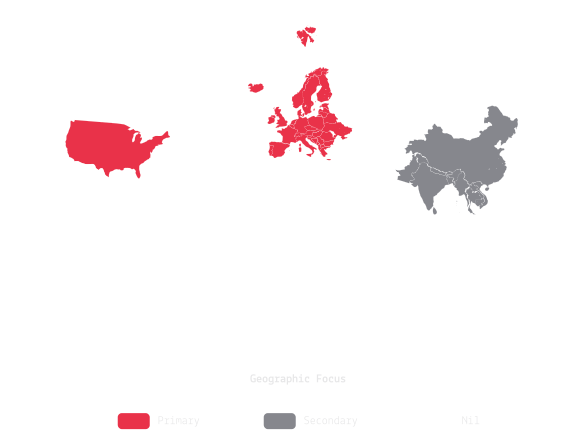
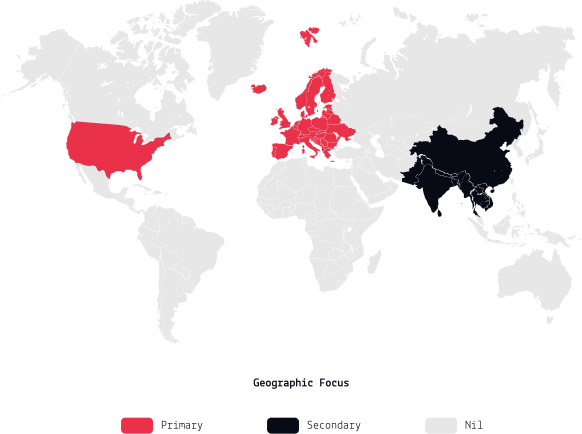
Global AI innovation remains concentrated in a few major regions — North America (US), Europe, and Asia-Pacific, but with notable differences.
- North America (US) — leading in R&D, infrastructure and frontier AI: Many of the most ambitious breakthroughs (BoltzGen, ISS Robotics, synthetic-data research, quantum-AI patent surges) originate in US institutions or companies.
- Europe — regulatory push, government-backed AI investment, and talent realignment: For instance, in the UK the government has announced major additional investment aimed at boosting AI businesses and job creation. Also, the return to Europe of influential researchers (e.g., as reported by media that a leading AI scientist will launch a start-up in Paris) suggests continued European ambition.
- Asia-Pacific — growing interest in “agentic AI customer experience” for telecom, commerce, and local language modeling: At the recent AI Innovation Asia 2025 conference, representatives from major regional firms (e.g., a major telecom vendor) emphasised the potential of agentic AI for customer-facing services.
In summary: the US remains the leader in frontier R&D and infrastructure; Europe leverages regulation + talent to compete; Asia-Pacific is carving out niches in AI-powered customer experience and localisation.
Adoption of New Technologies
Agentic AI, Multimodal & Generative AI
- The roll-out of Gemini 3 and Nova 2 signals a shift toward agentic, multimodal AI, not just text LLMs but reasoning across images, code, audio and video. Google positions Gemini 3 as powering core services such as Search, Gmail, Maps, turning AI into infrastructure for everyday digital life.
- Enterprises are embedding AI agents into business operations: scheduling, customer interaction, CRM, call centre automation (eg via Amazon Connect), demonstrating that AI is gaining traction beyond experimental pilots.
Compute infrastructure, synthetic data and efficient models
- The rise of synthetic data generation and data-efficient methods addresses one of the critical bottlenecks: lack of sufficient high-quality training data.
- At the same time, there is growing investment in hardware and efficient AI models (especially for embedded / low-power use cases), improving feasibility of deploying AI outside data-centre environments.
Robotics, Embodied & Physical-World Interactions
- Robotics adoption is gaining momentum: a machine-learning system on the ISS recently enabled autonomous robot movement planning 50–60% faster, a significant step for robotics in constrained, remote, or high-stakes environments.
- In parallel, academic research in “embodied AI” (merging large (or multimodal) models with “world models” for environment-aware planning) is expanding. The recent paper titled Embodied Artificial Intelligence: From LLMs to World Models articulates this paradigm shift toward AI that understands and interacts with the physical world.
AI for Science, Health, Environment
- Use of AI to accelerate scientific discovery is rising sharply. For example, BoltzGen can design protein binders for any biological target, potential game-changer for drug discovery.
- Public-sector and institutional backing is increasing: governments such as in the UK are announcing strategic packages aimed at growing AI-driven businesses and jobs.
- Interdisciplinary research programmes are gaining funding, e.g., AI projects in health, environmental conservation, plastic recycling and climate resilience.
In aggregate, these technology adoptions signal a maturing of AI: from flashy demos to foundational infrastructure, R&D platform, and production-grade deployment across domains.
Research and Development (R&D) Breakthroughs
Notable Scientific & Technical Advances
- Protein-binder design from scratch: The MIT model BoltzGen can generate novel protein binders for arbitrary biological targets, drastically accelerating and broadening drug discovery pipelines.
- Neuromorphic/brain-like computation: Researchers at University of Southern California (USC) built artificial neurons using ion-based diffusive memristors, capable of replicating biological neuron signal processing.
- Embodied AI architectures: The paper Embodied AI: From LLMs to World Models (2025) charts a path from purely digital models to systems that can reason about and interact with the physical world, combining semantic reasoning (LLMs) with world models for physics-compliant interaction.
- AI in robotics for space operations: On board the ISS, ML-based systems helped a robot plan autonomous movements 50–60% faster, pushing autonomous robotics into more demanding real-world domains.
- Quantum-AI convergence and IP surge: According to a recent report (e.g., from Marks & Clerk), patent activity around Quantum AI (QAI) has surged, indicating increased corporate and academic investment in next-generation AI + quantum computing synergies.
The Context & Potential Impact
- These breakthroughs suggest that AI is moving beyond narrow tasks (e.g., language generation or classification) into scientific discovery, material design, robotics, and physical-world interaction, domains that require high fidelity, robustness, explainability and often domain-expert knowledge.
- The combination of neuromorphic approaches, embodied AI, synthetic data, and quantum-AI suggests a long-term evolution: AI may gradually shift from purely statistical models to systems that approximate biological cognition or physical reasoning, a possible pathway toward more general-purpose, robust AI.
Market Impact and Consumer Adoption Signals
Survey and Corporate Adoption Signals
- The 2025 edition of McKinsey & Company’s “State of AI” survey finds that while AI usage is widespread, organisations that treat AI as strategic infrastructure, with clear management processes, human validation, and cross-functional adoption, are the ones seeing meaningful value.
- The narrative is shifting: as one analysis puts it, AI is no longer “just tools.” It’s becoming “infrastructure, strategy, and (increasingly) competitive advantage.”
Consumer & Public Signals
- On the consumer side, widespread roll-out of models like Gemini 3 via search, Gmail, Maps, integrated into services people already use, suggests high potential for mass adoption and behavioural shift.
- In specialised domains (science, health, environment), early enthusiasm among researchers and institutions is notable, though it remains to be seen whether these will translate into consumer-facing applications soon.
Risks, Barriers, and Criticisms
- There is growing concern about “an AI investment bubble,” with some arguing that valuations and expectations may exceed realistic near-term returns.
- The gap between pilots and scaled, sustainable deployment remains: many organisations lack governance practices, data maturity or integration capability to move from prototypes to operational AI at scale.
- The shift toward more powerful agents raises ethical, regulatory and safety questions. For example, complexity of decision-making and “agentic” behaviour may trigger concern over accountability and bias, especially as agents are embedded into widely used services. As noted by experts at policy forums, much of the hype needs to be evaluated skeptically.
Disruptive Competitors and Innovation-led Market Shifts
- New entrants and start-ups focused on frontier AI — e.g., the team behind Nova Forge / Amazon’s Nova 2 seeks to challenge incumbents by offering customisable “frontier” models to businesses, not just tech giants.
- Science-first AI ventures — BoltzGen (MIT) and robotics-oriented embodied-AI research highlight a shift toward companies with science-based missions (health, environment, engineering) rather than pure consumer apps.
- Companies leveraging custom infrastructure — the surge in Quantum AI patenting and neuromorphic R&D suggests that new business models may emerge around specialized compute, secure data handling, synthetic data provision, scientific-AI platforms.
- Platform competition and diversification — As giants (Google, Amazon) integrate AI deep into infrastructure and services, other players (start-ups, academic spin-outs) are positioning themselves around specialisations (science, robotics, privacy, synthetic data), which may fragment the market but also fuel faster domain-specific innovation.
Established players seem to be responding conservatively: embedding AI quietly, investing in infrastructure, emphasising oversight and compliance (e.g., with Amazon Connect’s new emphasised transparency features).
Actionable Recommendations
Based on the evidence above, here are recommendations for organisations, investors and decision-makers:
- Invest in frontier AI infrastructure and custom models: Given the rise of tools like Nova Forge and in-house compute efforts, organisations should experiment with domain-specific AI models built on their own data, especially if they operate in regulated or specialised industries.
- Explore AI for science, healthcare, environment, and R&D-heavy operations: Breakthroughs like BoltzGen show that AI can accelerate discovery in biology, materials science, and more. Institutions and companies with R&D arms should consider pilot programs to harness AI for early-stage research.
- Adopt “AI as infrastructure” mindset: Treat AI not as an optional project, but as a core part of operations, invest in AI governance, human-in-the-loop validation, data infrastructure, and scaling practices. The organisations capturing most value already do this.
- Monitor and engage with embodied AI and robotics developments: As robotics + AI matures (e.g., for automation, logistics, space, environment), companies in manufacturing, logistics, aerospace, environment monitoring should assess whether such technologies could disrupt or benefit their operations.
- Stay alert to regulatory, ethical, and safety considerations: Given rising agentic AI adoption, investments in compliance, transparency, responsible AI practices, and human oversight are essential. Collaborations with regulators and civil society may provide competitive advantage.
- Foster partnerships between academia, industry, and government: Many of the most promising innovations, particularly in science, health, robotics, come from academic or government-supported research. Organisations should consider consortia or public-private partnerships to accelerate deployment and share risk.
- Pilot with controlled deployments before wide roll-out: Given uncertainties around performance, safety, and ROI, initial use cases should be scoped, monitored, and measured carefully, especially for high-risk areas (health, critical infrastructure, customer data).
Emerging Risks and Strategic Considerations
- Potential overvaluation / “AI bubble” risk: The scale of investment remains massive, but returns are not yet guaranteed; firms should avoid over-committing on unproven use-cases.
- Skill and organisational gaps: Many companies lack the human capital, data practices, or governance structures necessary to move beyond pilots, investing in training and operational readiness is key.
- Regulatory & societal pressure: As AI becomes more embedded, scrutiny over safety, bias, data privacy, and transparency will increase. Firms must be proactive in compliance and ethical design.
- Infrastructure and resource constraints: AI infrastructure demands (compute, data, energy) may strain resources, organisations need sustainable strategies and resilience planning.
Conclusion
The last six months have consolidated a transformation: AI is evolving from experimental novelty to critical infrastructure, scientific accelerator, and enterprise-level competitive advantage. With major new releases (Gemini 3, Nova 2), breakthroughs in science and robotics (BoltzGen, ISS robotics, embodied AI), and growing institutional investment and adoption, the structural shift is well underway. For leaders, the time is ripe to stop treating AI as a side-project and begin embedding it into core strategy, while remaining mindful of the ethical, operational, and regulatory challenges ahead.